


- Szczegóły

Abstrakt:
The study focuses on the remains recovered from two key areas: Siniya Church and the Siniya Late Antique Settlement (LAS), which comprise approximately 18,000 bone fragments. The Late Antique Settlement, characterised by the houses of merchants and fishermen, dates back to the 4th–5th centuries CE, while Siniya Church includes the remnants of a Christian monastery from the 7th–8th centuries CE. Archaeoichthyological analysis identified fish from 28 different families consumed by the inhabitants of these two locations, though only a few were predominant. The study explores diachronic patterns in fish consumption and fishing practices at each location, and how these reflect differences in the social status of their respective inhabitants.

- Szczegóły
W dn. 13 czerwca w podcieniach Pałacu Staszica w Warszawie odbyła się wystawa tryptyku graficznego "Symbole nas łączą" autorstwa dr Anetty Łyżwy-Piber, organizowana w ramach Europejskich Dni Archeologii. Wystawie towarzyszyła prezentacja pt. "Jerozolima Erica Matsona (Zdjęcia z kolekcji IKŚiO PAN)".
Tryptyk graficzny pt. „Symbole nas łączą” prezentuje gest błogosławiącej dłoni w JUDAIZMIE, CHRZEŚCIJAŃSTWIE i ISLAMIE. We wszystkich tych religiach symbole te mają to samo ochronne znaczenie. Są amuletami. Przywracają spokój doczesny i duchowy. Są znakiem pokoju. Uświadamiają, że mimo różnic religijnych i kulturowych mamy wspólne symbole i ich kody znaczeniowe, a te trzy religie są ze sobą powiązane i mają wspólne bliskowschodnie korzenie. Łączą symbolicznie wspólnoty wyznawców tych religii.


- Szczegóły
INSTYTUCJA: Instytut Kultur Śródziemnomorskich i Orientalnych Polskiej Akademii Nauk
MIASTO: Warszawa
STANOWISKO: praktyki studenckie w bibliotece archeologicznej
DATA OGŁOSZENIA: 2 czerwca 2025 r.
TERMIN SKŁADANIA OFERT: 20 czerwca 2025 r.
PRZEWIDYWANY TERMIN ROZPOCZĘCIA PRAKTYK: 1 lipca 2025 r.
LINK DO STRONY: www.iksiopan.pl

- Szczegóły

Herodotus (2.35) tells us that in ancient Egypt all the customs are contrary to the rest of the world: women trade, while men stay in the house, and the former enjoy far greater freedom than anywhere else. But is this vision of ancient Egyptian society, progressive as it may seem, supported by Egyptian evidence or is it just a creation of the Greek historian? How can we approach the subject of women and the female viewpoint in the past based on textual or iconographic evidence primarily produced by men and thus largely reflecting male perspective? Can material culture help us add nuance to the picture without oversimplifying individual experiences?
We are delighted to announce that the programme of the conference “Women’s Perspectives in the Nile Valley”, which will take place from 25th to 27th June 2025 in Warsaw (Faculty of Archaeology, University of Warsaw), as well as the book of abstracts, is now available (see below).
The event focuses on female experiences and perspectives in ancient Egypt and Nubia, addressing divine, royal, elite, and non-elite spheres. It also explores the history of exploration and the role of women in the study of the ancient Nile Valley.
While the conference was originally planned as an in-person event, due to great interest we have decided to transform it into a hybrid format. If you wish to receive a link to the livestream, please send an email to .
Abstracts available here.
Conference programme available here.
We look forward to welcoming you to Warsaw and online!
The Organising Committee
Ewa Józefowicz (Institute of Mediterranean and Oriental Cultures PAS)
Marta Kaczanowicz (Faculty of Archaeology UW)
Filip Taterka (Institute of Mediterranean and Oriental Cultures PAS)

- Szczegóły

Abstrakt:
This talk explores the rise, expansion and decline of monasteries in East Arabia during the sixth to eighth centuries CE, evaluating it in the context of the increasing influence of East Syrian (Nestorian) Christianity in the late Sasanian empire, the imperial ambitions of the Sasanian emperors in Arabia, and the emergence of an Islamic state that conquered and appropriated the Sasanian lands and gradually asserted its authority over East Arabia and the Gulf. It is also discussed whether this latter phenomenon brought about the demise of the monasteries of East Arabia.

- Szczegóły
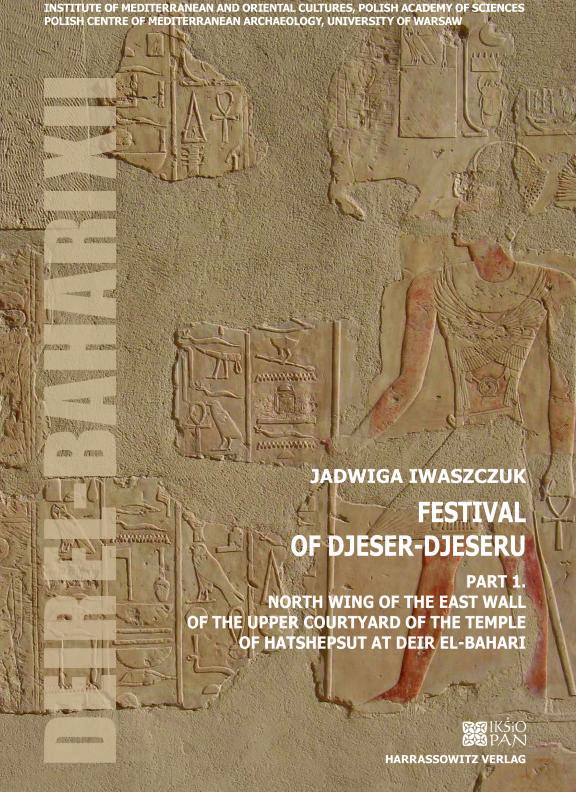
Miło nam poinformować, że ukazał się nowy tom z serii Deir el-Bahari:
Jadwiga Iwaszczuk
Festival of Djeser-djeseru
Part 1. North wing of the east wall
of the Upper Courtyard of the temple of Hatshepsut at Deir el-Bahari

Dofinansowano ze środków budżetu państwa, przyznanych przez Ministra Nauki i Szkolnictwa Wyższego w ramach Programu „Doskonała nauka II” (MONOG/SP/0006/2023/01).
- Szczegóły
Z wielką radością informujemy, że nasz Instytut weźmie udział w nadchodzącym 28. Pikniku Naukowym! To wyjątkowa okazja, aby bliżej poznać naszą działalność, uczestniczyć w fascynujących pokazach i spotkać nasz Zespół.
Podczas wydarzenia zaprezentujemy 3 pokazy:
1. "Staroegipska droga do gwiazd" - pokaz mający na celu przedstawienie znaczenia wiedzy o wszechświecie: słońcu, księżycu i gwiazdach dla rozwoju cywilizacji Egiptu. Jak w starożytności wyobrażano sobie wszechświat? Jaki miał wpływ na rozwój wyjątkowej sztuki i architektury starożytnego Egiptu? Odpowiedzi znajdziemy dzięki informacyjnej wystawie oraz pasjonującej grze.
2. "Starożytni budowniczowie megalitów z Libanu i ich miejsce w kosmosie" - pokaz poświęcony tajemnicom starożytnych budowniczych i ich związku z niebem. Czym są megality? I kim byli ich budowniczowie? Co wiedzieli o kosmosie? I dlaczego interesują się nimi archeolodzy? Zobaczymy model 3D i dowiemy się więcej o Libanie.
3. "Motywy kosmiczne i kosmogoniczne zamknięte w antycznej ceramice" - pokaz dotyczący tego, jak starożytni artyści i rzemieślnicy wyobrażali sobie wszechświat na swoich naczyniach. Spróbujemy swoich sił w lepieniu, dekorowaniu i malowaniu naczyń z kosmicznymi motywami.
Serdecznie zapraszamy wszystkich miłośników nauki, rodziców, nauczycieli oraz uczniów do odwiedzenia naszego stoiska. Zachęcamy do nawiązania cennych archeologiczno-orientalistycznych kontaktów i spędzenia czasu w inspirującej atmosferze.
Czekamy na stoisku D11 w Strefie Cywilizacji. Do zobaczenia na Pikniku Naukowym!
