


- Details
- Category: Wokół Szlaku Jedwabnego
- Hits: 4286
Lost Buddhist Culture Reflected in Tocharian Literature
(Hiromi Habata, International College for Postgraduate Buddhist Studies in Tokyo)
The Central Asian expeditions around the beginning of the 20th century brought us valuable manuscript fragments from the ruins along the Silk Road. The manuscripts are written in a variety of languages, among which the existence of unknown languages has attracted the attention of scholars. One of the unknown languages is called Tocharian, after the monumental decipherment of the language by the German scholars: Emil Sieg and Wilhelm Siegling. The Tocharian fragments reveal not only the lost valuable language of the Indo-European family, but also the lost Buddhist culture which flourished in the region of Kucha. Tocharian literature contains a variety of genres and also shows a range of Buddhist cultural dimensions. Besides the canonical texts in Sanskrit and Tocharian, Tocharian Buddhism conspicuously transmits to us the popular cultural heritage, such as Buddhist theatre and music.
Hiromi Habata, Prof. Dr. phil. habil.
She researched at LMU Munich and at Leipzig University after her study of Indology at Hokkaido University and at the University of Freiburg. Since 2020, she has been Professor at International College for Postgraduate Buddhist Studies in Tokyo. Her publications include: Die zentralasiatischen Sanskrit-Fragmente des Mahāparinirvāṇa-mahāsūtra, Marburg 2007; A Critical Edition of the Tibetan Translation of the Mahāparinirvāṇa-mahāsūtra, Wiesbaden 2013; Aufbau und Umstrukturierung des Mahāparinirvāṇasūtra, Bremen 2019; Olav Hackstein, Hiromi Habata, Christoph Bross: Tocharische Texte zur Buddhalegende, Dettelbach 2019.
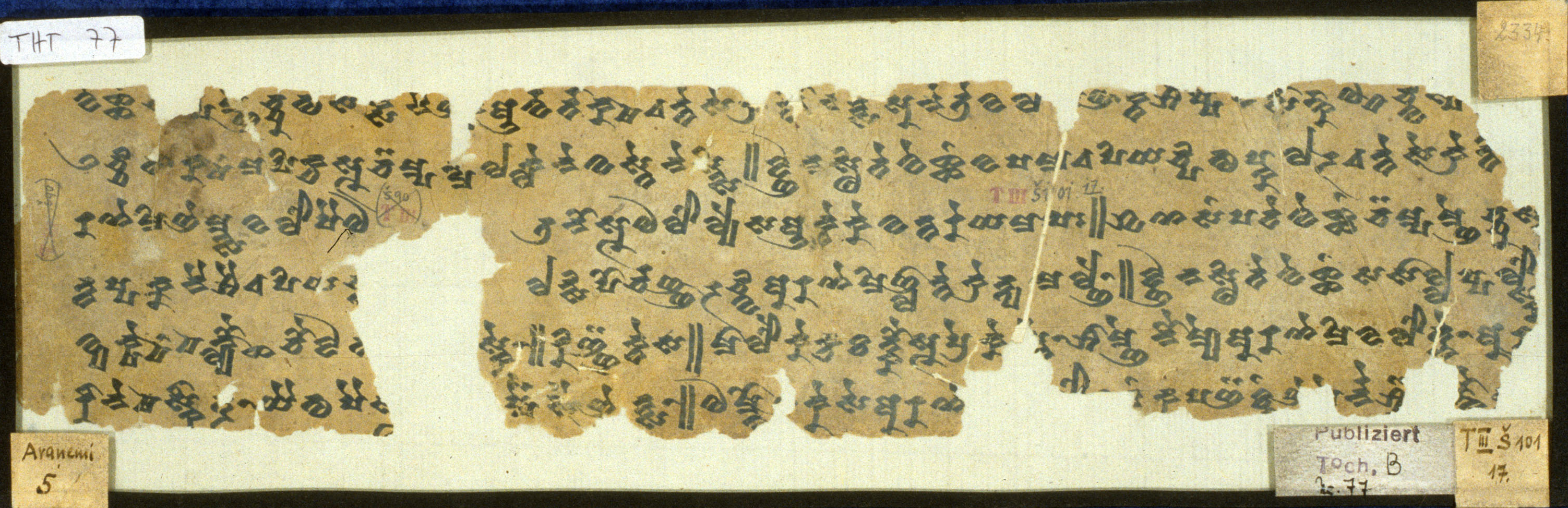
Manuscript of the Tocharian Araṇemi-Jātaka (B77)
- Details
- Category: Wokół Szlaku Jedwabnego
- Hits: 8934
The teachings of the Buddha were initially transmitted orally, on the organizational model of the Vedic schools, but without their insistence on a linguistic standard and immutability of textual form. As a consequence, Buddhist texts adopted the dialects of the new regions to which they were brought and began to develop in new literary genres. It is the far northwestern region of Gandhāra (modern Pakistan and Afghanistan) that has preserved the oldest written Buddhist texts for us (dating as far back as the first century BCE), laid down in the local Prakrit Gāndhārī and the local script Kharoṣṭhī on birch-bark scrolls. The rediscovery and study of these manuscripts since the 1990s has cast much new light on the early history of Buddhism, its transmission to Central Asia and China, and processes such as the beginnings of literacy in South Asia and Buddhist canon formation and hermeneutics. This lecture will present an overview of these new manuscript discoveries and what we have learned from them so far, and take a detailed look at the transmission of selected early Buddhist canonical texts in Gandhāra and their treatment by local exegetes.
Dr Stefan Baums is a well-known specialist in Gandhāran texts, author of many articles on the subject and, together with Dr Andrew Glass, a winner of the Aming Tu Prize for the outstanding website https://gandhari.org. Dr Stefan Baums studied in Göttingen and London and received his PhD from the University of Washington. Since 2012 he has been Lead Researcher at the Bavarian Academy of Sciences and Humanities and is responsible for the project “Buddhist Manuscripts from Gandhāra”.
 Relief with the Buddha during the school visit (The Museum Fünf Kontinente, Munich)
- Details
- Category: Wokół Szlaku Jedwabnego
- Hits: 5003
Wokół Szlaku Jedwabnego
I. Spotkanie kultur
(Seria wykładów online zorganizowana przez Pracownię Kultur Szlaku Jedwabnego)
Rola szlaków handlowych zwykle daleko wykraczała poza proste zaspokojenie potrzeb materialnych danej społeczności, poza dostarczenie potrzebnych produktów i umożliwienie wymiany bądź sprzedaży własnych. Z perspektywy wieków znaczenie kulturowe szlaków przerasta ich czysto ekonomiczną wartość. Nawet towary, którymi dawniej handlowano, są obecnie cenne przede wszystkim jako źródło informacji o przeszłych kulturach.
Kupcy nie stanowili zresztą jedynej grupy korzystającej ze szlaków handlowych. Równie ważni byli m.in. ciekawi świata podróżnicy, wysłannicy, urzędnicy czy też mnisi, głoszący swą wiarę lub udający się do odległych krajów w poszukiwaniu nauk. Wszyscy oni przyczynili się do tego, że szlaki handlowe, a w szczególności miejsca postoju, oazy i miasta nierzadko stawały się tętniącymi życiem centrami wymiany intelektualnej.
Jednym z najbardziej znanych szlaków handlowych, do dziś silnie oddziałującym na wyobraźnię, jest Szlak Jedwabny. Nazwa ta może być myląca, gdyż nie mamy tu do czynienia z jednym szlakiem, ale raczej z siecią dróg lokalnych znajdujących się w Azji Centralnej i Wschodniej, a prowadzących do krajów basenu Morza Śródziemnego. Dodatkowo, droga morska połączyła szlak lądowy z jednej strony z krajami Azji Południowej, Południowo-Wschodniej i Wschodniej, a z drugiej – z południowo-wschodnim Śródziemnomorzem, Afryką Wschodnią i Arabią Południową. Nie dziwi więc, że niewiele osób brało na siebie trudy podróży po całym Szlaku Jedwabnym, w szczególności lądowym, a i handel tam się odbywający miał przede wszystkim lokalny charakter. Podobnie, nawet jedwab ani nie był jedynym produktem transportowanym po Szlaku, ani nie zawsze odgrywał tam najważniejszą rolę.
Planowane wykłady będą poświęcone różnym aspektom związanym ze Szlakiem Jedwabnym i wymianą kulturową, która się na nim i wokół niego dokonywała. Pierwszy cykl tych wykładów, który odbędzie się w roku akademickim 2020/21, daje wgląd w bogactwo zagadnień związanych ze Szlakiem Jedwabnym, ale z oczywistych względów nie wyczerpuje tej tematyki. Oprócz wprowadzenia do przedmiotu badań poruszone zostaną m.in. kwestie dotyczące sztuki, zabytków kultury piśmienniczej, religii czy też archeologii. Wszystkie te wątki będą kontynuowane i pogłębiane w przyszłości.
Niezmiernie cieszymy się, że dla tego pierwszego cyklu udało nam się pozyskać tak znakomitych prelegentów jak m.in.: prof. dr Diwakar Acharya (Oxford), dr Stefan Baums (Monachium), dr hab. Dragomir Dimitrov (Marburg), dr hab. Erika Forte (Kyoto), prof. dr hab. Hiromi Habata (Tokio), prof. dr hab. Marek Mejor (Warszawa), prof. dr hab. Monika Zin (Lipsk).
Wykłady odbywają się online (przy pomocy MS Teams) i są ogólnodostępne.
Osoby zainteresowane prosimy o kontakt pod adresem .
Harmonogram
27 listopada 2020 r. o godz. 17.00: prof. dr. hab. Marek Mejor, „Szlak Jedwabny: na skrzyżowaniu kultur”.
18 grudnia 2020 r. o godz. 17.00: prof. dr hab. Monika Zin, ,,Buddyjskie malowidła ścienne z rejonu Kuča na Północnym Jedwabnym Szlaku“.
22 stycznia 2021 r. o godz. 17.00: dr Stefan Baums, „Buddhist Manuscripts from Gandhāra: The Word of the Buddha and His Commentators“.
26 lutego 2021 r. o godz. 17.00: dr hab. Dragomir Dimitrov, „On the Buddhist Indus Script and Scriptures of the Sāṃmitīyas“.
12 marca 2021 r. o godz. 10.00: prof. dr hab. Erika Forte, „New Ruins in an Old Context: The Buddhist Site of Toplukdong (Domoko) in Khotan (7th–9th c. CE)”.
23 kwietnia 2021 r. o godz. 17.00: prof. dr Diwakar Acharya, „Bodhisattva Becomes Shiva: On the Trans-Himalayan Cult of Lokeshvara Worship and its Reinterpretation in Pre-Modern Times”.
7 maja 2021 r. o godz. 10.00: prof. dr hab. Hiromi Habata, „Lost Buddhist Culture Reflected in Tocharian Literature”.
14 maja 2021 r. o godz. 17.00: prof. dr hab. Max Deeg, „A 7th Century Record of a Gateway to India: The First Chapter of Xuanzang’s Datang Xiyu ji (Record of the Western Regions)”.
28 maja 2021 r. o godz. 17.00: prof. Steven Sidebotham, „ An Ancient Merchant’s Journey from India to Alexandria in Roman Times”.